
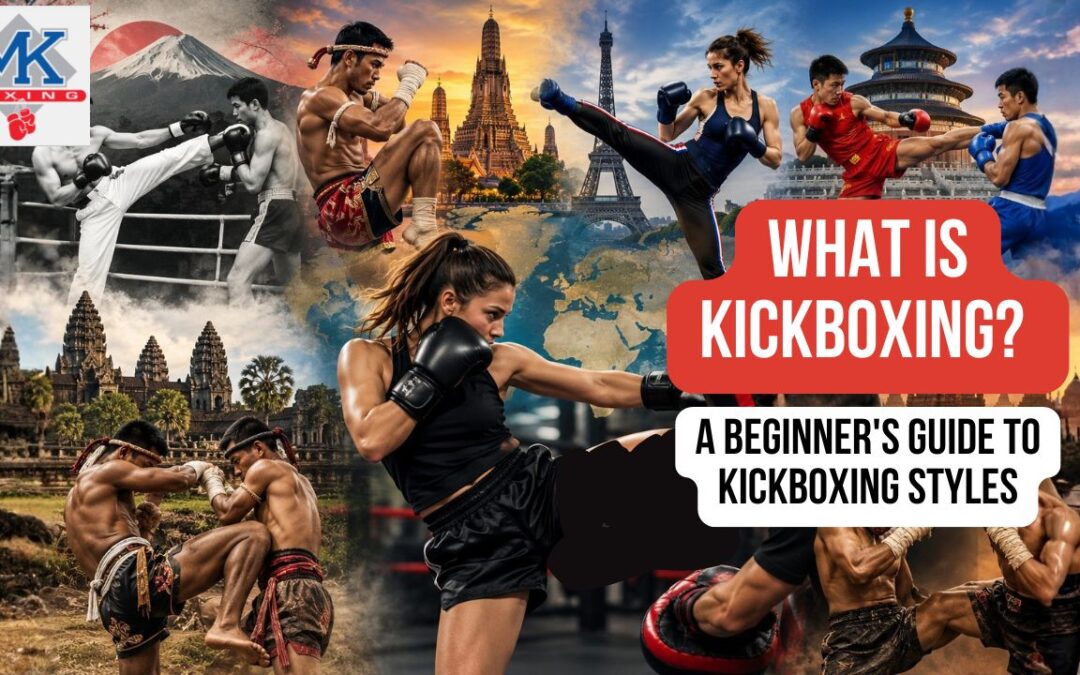
Punches. Kicks. Fast combinations. Footwork. Conditioning. At first glance, kickboxing seems easy to define: boxing with kicks.
But start exploring the sport and things quickly become more interesting.
The word “kickboxing” can describe a particular combat sport with its own rules, but it is also sometimes used more broadly for stand-up fighting systems that combine punches and kicks.
Around the world, different martial traditions developed their own approaches to striking. Japanese kickboxing, Muay Thai, Savate, Sanda, Kun Khmer and Lethwei may look similar to a newcomer, but they aren’t simply different names for the same sport.
Each has its own history, techniques, rules and cultural identity.
So what exactly is kickboxing—and how did so many different styles of stand-up fighting develop?
What Is Kickboxing?
Kickboxing is a striking-based combat sport and training style that combines punching techniques with kicks.
Depending on the rules and style, training may also incorporate additional techniques, defensive movement, footwork and different forms of partner or pad work.
Modern kickboxing can be practiced for several reasons: Fitness and conditioning, Learning striking skills, Coordination and balance, Competition, Martial arts training, Personal challenge.
Not everyone who trains kickboxing wants to fight competitively.
For many people, the appeal is the combination of learning a skill and getting a demanding full-body workout at the same time.
Where Did Kickboxing Come From?
There isn’t one ancient martial art from which every form of kickboxing descended. Humans have developed striking systems involving hands and legs in many parts of the world for centuries.
What we now call modern kickboxing, however, became particularly associated with Japan during the 20th century.
Japanese martial artists were interested in developing a full-contact fighting format that allowed competitors from different striking backgrounds to test their techniques against one another.
Influences from karate and Thai boxing (Muay Thai) played an important role in this development.
By the 1960s, Japanese kickboxing was emerging as a recognizable combat sport, and the concept subsequently spread internationally.
Over time, different competitive organizations developed their own rules. Kickboxing also became increasingly popular outside competitive fighting as people discovered that punches, kicks and combinations could provide an engaging form of fitness training.
Today, “kickboxing” can therefore mean slightly different things depending on the gym, country and ruleset.
So Are All of These Really Kickboxing Styles?
Not exactly. This is where the narrow and broad meanings of the word kickboxing become important.
In the narrow sense, kickboxing refers to combat sports that specifically developed and identify themselves as kickboxing, including Japanese kickboxing and later international competitive formats.
In a broader conversational sense, people sometimes use “kickboxing” as an umbrella description for stand-up striking sports in which both punches and kicks are permitted.
That’s why you may see Muay Thai, Savate, Sanda, Kun Khmer and Lethwei grouped together in discussions about “kickboxing styles.”
But each deserves to be recognized as a distinct martial art or combat sport.
Think of them as members of a larger family of stand-up striking traditions—not identical versions of one sport.
Japanese Kickboxing
Modern Japanese kickboxing developed during the mid-20th century from encounters between Japanese martial arts and Thai boxing.
Karate practitioners were interested in striking techniques under more continuous, full-contact conditions.
The resulting sport combined elements of karate and boxing with techniques and influences from Muay Thai.
→ Explore Muay Thai Classes at MK Boxing
Japanese kickboxing helped establish many of the characteristics people now associate with competitive kickboxing:
- Punch-and-kick combinations
- Continuous full-contact striking
- Ring competition
- Timed rounds
- Protective boxing gloves
- Structured competitive rules
As the sport developed, organizations adopted different regulations regarding techniques such as knees, clinching and particular types of kicks.
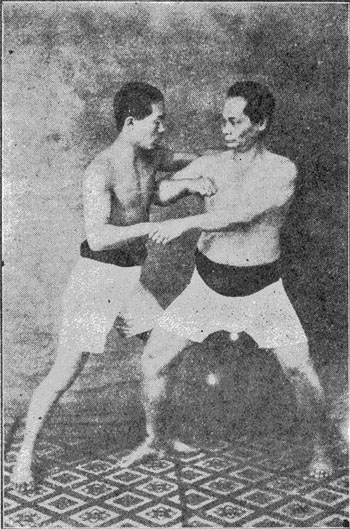
– The Japanese book “沖縄拳法唐手術” (Okinawa Kenpou Karate Jutsu), Public domain, via Wikimedia Commons

Savate: French Boxing
Not every kickboxing-style martial art developed in Asia.
Savate, also called French boxing, developed in France and combines punching with distinctive kicking techniques. Its history and technical approach differ from Asian striking systems, and practitioners traditionally wear specialized footwear.
Savate became a codified combat sport with its own rules, terminology and competitive tradition. It provides a fascinating reminder that combining hand and foot strikes wasn’t an idea developed in only one part of the world.
Different cultures arrived at their own versions of stand-up striking.
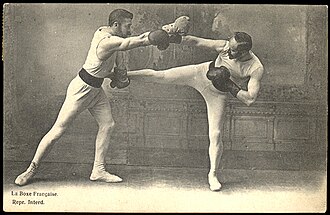
, CC BY-SA 3.0, via Wikimedia Commons

Sanda: Chinese Full-Contact Fighting
Sanda, sometimes called Sanshou, is a modern Chinese combat sport developed from Chinese wushu.
It combines punches, kicks, throws, takedowns, and defensive techniques.
That last part makes Sanda particularly interesting when comparing striking sports: a Sanda competitor isn’t only thinking about punches and kicks. The possibility of being thrown or taken down changes distance, movement and strategy.
Competitive Sanda is traditionally fought on an elevated platform called a leitai, although competition formats can vary.
Because it combines striking with throwing techniques, Sanda occupies a somewhat different space from many conventional kickboxing rulesets.
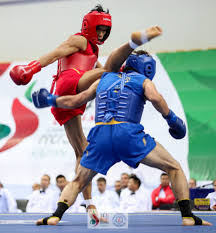
Ziyad12king, CC0, via Wikimedia Commons

Kun Khmer: Cambodia’s Striking Tradition
Kun Khmer, also historically known in sporting contexts as Pradal Serey, is Cambodia’s traditional stand-up fighting sport.
It uses striking techniques including punches, kicks, knees and elbows and shares some visible similarities with neighboring Southeast Asian striking traditions.
But Kun Khmer should be understood within Cambodia’s own martial and cultural history, rather than simply being treated as a variation of another country’s sport.
Cambodia also has the broader traditional martial art Kun Lbokator, whose history is reflected in ancient temple imagery and which remains an important part of Cambodian cultural heritage.
The existence of these traditions shows just how deep the history of martial arts runs throughout Southeast Asia.
Lethwei: Myanmar’s Bare-Knuckle Boxing
Myanmar has another distinctive striking tradition called Lethwei, or Burmese boxing.
Lethwei is particularly recognizable because traditional competition uses wrapped hands rather than conventional boxing gloves and permits techniques—including headbutts—that distinguish it from most modern kickboxing formats.
For this reason, Lethwei is sometimes called the Art of Nine Limbs.
Its striking arsenal can include: Punches, Kicks, Knees, Elbows, Headbutts
Traditional Lethwei therefore represents a considerably different competitive environment from the kickboxing class most recreational students would encounter in an American gym.
Like Muay Thai and Kun Khmer, it is better understood as its own martial tradition rather than simply being labeled a “type of kickboxing.”
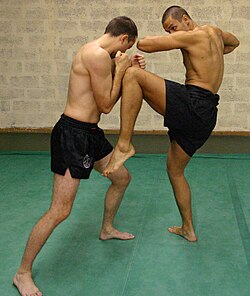
Krystof Gauthier (France), CC BY-SA 3.0, via Wikimedia Commons

From Combat Sport to Fitness Around the World
Kickboxing’s evolution is an interesting example of how martial arts continue to change.
What developed as a competitive striking sport also became a popular way for ordinary people to train.
Today you’ll find competitive fighters practicing kickboxing alongside people who simply want an alternative to conventional gym workouts.
Some are interested in martial arts.
Some want better conditioning.
Some love learning technique.
Some enjoy hitting the heavy bag after a stressful day.
And some simply discovered that kickboxing is a workout they actually look forward to doing.
Different goals.
Same first step:
Learning the fundamentals.
Experience Kickboxing at MK Boxing
Reading about Japanese kickboxing, Muay Thai, Savate, Sanda, Kun Khmer and Lethwei shows just how diverse the world of stand-up striking really is.
But you don’t need to choose a martial arts history specialty before trying your first class.
At MK Boxing in Billerica, MA, our kickboxing classes combine punches, kicks, combinations and conditioning in training designed to keep your body moving and your mind engaged.
Beginners are welcome.
Learn the fundamentals. Hit the bags and pads. Improve your technique. Build your conditioning.
And discover why kickboxing keeps so many people coming back.
→ Explore Kickboxing Classes at MK Boxing
→ Try Your First Class for $10
Move. Strike. Learn. See where kickboxing takes you.